

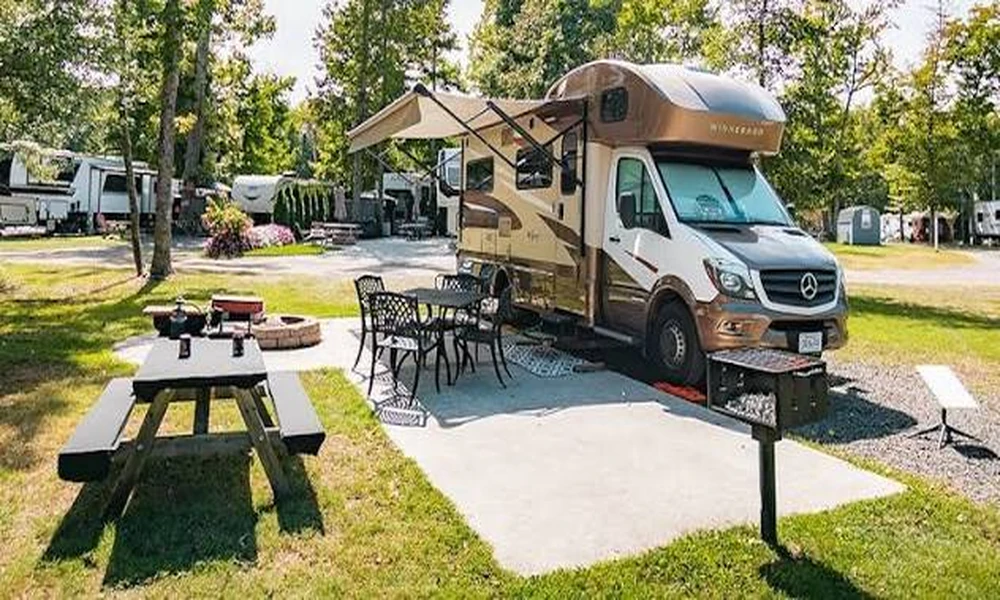
Most first-time RV buyers pick a rig they love the look of, then spend two summers figuring out it’s the wrong one for where they actually travel. New England is a specific region with specific demands: tight back-road campgrounds in the Berkshires, salty coastal air on Cape Cod, hard winters in Vermont that expose every poorly insulated seam. Get the match wrong and a beautiful rig becomes a liability.
This guide gives you a clear way to think through that match before you commit.
Why New England Rewards Careful Rig Selection
New England isn’t the open-road Southwest. Campsite spacing runs tighter, roads narrow fast once you leave the interstate, and the season swings from shoulder-cold April to humid August to leaf-peeping October. Your rig needs to handle all of it, or at least the slice of it you actually plan to use.
The outdoor travel economy that surrounds New England is massive. According to the U.S. Bureau of Economic Analysis, the outdoor recreation economy accounted for 2.4 percent, or $696.7 billion, of current-dollar U.S. GDP in 2024 – and Massachusetts was among the top five states for outdoor recreation growth from 2023 to 2024, posting a 6.9 percent increase , according to the BEA’s 2026 Outdoor Recreation Economic Statistics release. That level of activity means more campgrounds filling up faster, more traffic on the popular routes, and a stronger argument for owning a rig that fits the region rather than hoping a generic choice works out.
The practical upshot: a 42-foot Class A that crushes it in Florida State Parks will be miserable at a wooded Connecticut campground where sites max out at 35 feet. Size is the first decision, and it’s a regional one.
The NEST Framework for New England RV Shopping
Here’s a framework I’d call NEST, built specifically for this region. It covers the four variables that separate a good New England rig from a frustrating one.
- N – Narrowness. How wide and long can you go before roads and campsites push back? In rural Connecticut and Massachusetts, plan for sites under 40 feet and roads that don’t forgive a wide slide.
- E – Elevation tolerance. Vermont and New Hampshire grades will reveal every weakness in a heavy motorhome’s powertrain. Towable rigs behind a capable truck often handle altitude better than a gas Class A at full weight.
- S – Season range. If you’re camping April through November, four-season insulation, heated tanks, and a furnace that actually runs on propane (not just 12-volt) matter. A three-season trailer is a bargain until March hits.
- T – Tow or drive. Do you want one vehicle for everything, or are you fine unhooking and driving a separate tow vehicle into town? Travel trailers keep your car available. Class B camper vans stay compact and are ideal for the region’s narrow state parks.
Run your travel plans through those four filters before you walk onto any lot. You’ll eliminate half the options before the salesperson says a word.
Class B vs. Travel Trailer: The New England Dilemma
These two categories cover most of what works in this region. Here’s a side-by-side built on real-world New England use cases.
| Feature | Class B Camper Van | Travel Trailer (24-30 ft) |
|---|---|---|
| Average site length needed | Under 25 ft | 30-38 ft (combined) |
| Daily driving flexibility | High – park anywhere | Low – must unhook to explore |
| Living space | Compact, tight for 2+ people | Comfortable for families |
| Four-season options | Limited but growing | Wide selection available |
| Best New England use | Solo or couples, coastal day trips | Families, longer seasonal stays |
My honest pick for a couple doing two-week loops through Maine, New Hampshire, and Vermont? A Class B or a small Class C under 28 feet. You’ll thank yourself on Route 302 in Crawford Notch. Families with kids who need real beds and real dinette space should look hard at a mid-range travel trailer in the 26-to-28-foot range with a heated underbelly.
What the Numbers Say About Who’s Buying
RV buying isn’t a niche hobby anymore. The RV Industry Association reported that wholesale RV shipments finished 2024 at 333,733 units with a retail value of $20.27 billion , according to the RVIA’s 2024 RV Industry Profile. The towable segment, which includes travel trailers and fifth wheels, continues to dominate because the price of entry is lower and the flexibility at campgrounds is higher.
First-time buyers are a meaningful part of that mix. The median RV owner age is now 49, and 36 percent of current owners are first-time buyers – which means a lot of people are figuring this out without a trusted source to guide them. That gap is exactly why matching rig type to region matters so much before the purchase rather than after.
“The market is poised for additional growth with dealer inventories at healthy levels, continued strong consumer interest in RV ownership, and interest rates that are expected to ease.” – Craig Kirby, President and CEO, RV Industry Association, as cited in industry forecasts for 2025.
Healthy dealer inventory is actually good news for buyers. It means you have real negotiating room and, more importantly, time to be selective about finding the right rig rather than grabbing whatever’s available.
A Practical Checklist Before You Buy
Walk through this before you sign anything. These are the questions that will save you from a rig you stop using after year two.
- List your three most common trip types. Weekend warrior, week-long family vacation, or extended shoulder-season travel? Each points to different needs.
- Measure your typical campsite. Call ahead to two or three campgrounds you plan to use regularly and ask what their longest available site is. That number caps your rig length.
- Check your tow vehicle’s actual capacity. Not the marketing spec – the real payload-adjusted tow rating after passengers and gear. Many buyers discover their truck is underpowered after the purchase.
- Ask about heated tanks specifically. In New England, “winterized” and “four-season” mean different things. Confirm the tank enclosures are heated, not just insulated.
- Do a full walkthrough in the rain. Seriously. New England gets wet. Slide seals, roof vents, and entry door gaskets all show their character in water.
Working with a dealer who knows the regional quirks of New England camping will cut weeks off this process. An RV dealer serving Connecticut and Massachusetts who stocks and services rigs with the local climate in mind is a very different resource than a big-box dealer whose inventory is optimized for Sun Belt buyers.
Getting the Decision Right the First Time
New England is genuinely one of the great RV destinations in the country – once you’re in a rig that fits it. The campgrounds along the Maine coast, the Green Mountain state parks, the quiet fall routes through the Pioneer Valley in western Massachusetts: none of it gets old. What gets old is wrestling a 40-foot rig into a 35-foot site or freezing through an October night in a trailer with a three-season shell.
Use the NEST framework, run the checklist, and lean on regional expertise when you’re close to a decision. The right rig is out there. It just needs to match where you’re actually going, not where the showroom floor looks prettiest.
